
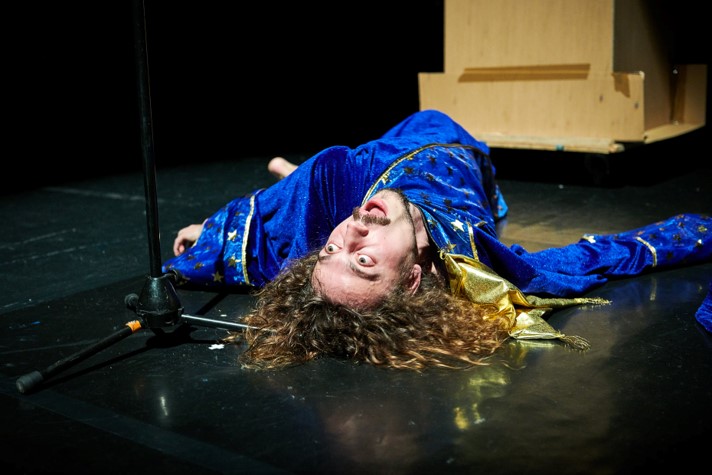
Based on Thomas Mann’s novel The Magic Mountain, Toverberg is the reinterpretation of the book by four actors and friends, members of Desnor. A glass of wine in hand, actor Timo Sterckx expresses his thoughts on the project and raises questions on what it is to be an artist.
Fondé sur le roman La Montagne magique de Thomas Mann, Toverberg est la réinterprétation du livre par quatre acteurs et amis, membres de la troupe Desnor. Un verre de vin à la main, l’acteur Timo Sterckx exprime ses pensées sur le projet et pose la question de ce que c’est qu’être un acteur.
You are all friends. How is it working with Louis Janssens and Ferre Marnef, founders of Desnor?
Vous êtes tous amis. Comment c’était de travailler avec Louis Janssens et Ferre Marnef, fondateurs de Desnor ?
It was great. We know each other very well, so we know what we can or cannot do. That is important. There was no wall, no boundary, we could do everything together.
C’était génial. On se connait tous très bien, donc on sait ce qu’on peut ou ne peut pas faire. C’est très important. Il n’y avait aucun mur, aucune barrière. On pouvait tout faire ensemble.
Working on the show was more collective then? Could you all bring your own ideas to the show or did Louis and Ferre take on the role of director?
Travailler sur ce spectacle était donc plutôt collectif ? Pouviez-vous amener vos idées ou Louis et Ferre tenaient-ils plus le rôle de metteur-en-scène ?
Yes, it was very collective. There was no big preparation. I think Louis is more of the director type; I guess he thinks a lot outside of the rehearsals. But I never do that. I always come to the theatre or the rehearsals “blanco”.
Oui, c’était très collectif. Il n’y avait pas de grande préparation. Je pense que Louis est de nature assez directive. Je suppose qu’il pense beaucoup en dehors des répétitions. Mais moi je ne fais jamais ça. J’arrive toujours au théâtre ou en répétition « blanco ».
Do you have to be in a certain mood to be fully in the process of making?
Devez vous être dans un certain état d’esprit pour être totalement dans le processus de création ?
Yes. The work is here, and when it stops, it stops for me. My mind is on other things.
Oui. Le travail, c’est ici, et lorsque nous avons terminé, j’ai terminé. Mon esprit se tourne vers d’autres choses.
« So the question was : what is an artist today? »
So the creation process started mainly with improvisation than with a written text?
Le processus créatif a donc plutôt commencé avec du jeu improvisé ?
In the beginning, the idea was “read the book”. So we read the book, and then we came together for the first time in July in Amsterdam during a week. We read all the parts that we loved to each other, and we classified them. Like: “this is political”, “this is about time”, “this is about love” … we made these sorts of classifications. We had so much! The book is 900 pages, so it’s very big and broad.
We started to improvise on the topics. But because the text is so difficult, we didn’t really know what to do about it or how to handle it. So, we tore it apart.
For example, there is a big snow scene in the book that is very important. We were like “okay, let’s improvise around the snow scene”. And we can do that because we know each other very well. It’s very difficult to improvise when you’re not familiar with the others: it’s embarrassing, or someone thinks it’s stupid. So stupid sometimes that you have a whole scene around it.
Au début, l’idée était « lire le livre ». Nous avons donc lu le livre, et nous nous sommes réunis la première fois à Amsterdam en juillet pendant une semaine. Nous nous sommes lu les parties qui nous plaisaient le plus, et nous les avons catégorisées. « Ca c’est plutôt politique », « ça c’est plutôt sur le temps », « ça c’est plutôt sur l’amour »… Nous avons fait ce genre de catégories. Nous en avions tellement ! Le livre fait 900 pages, il est très gros et divers.
Nous avons commencé à improviser sur les catégories. Mais le texte est si compliqué, on ne savait pas vraiment quoi en faire et comment gérer tout ça. Donc nous l’avons découpé.
Par exemple, il y a une scène dans la neige dans le livre qui est très importante. Nous nous sommes dit “d’accord, improvisons là-dessus.” Nous pouvons faire ça puisque nous nous connaissons très bien. C’est difficile d’improviser lorsque l’on ne connait pas les autres : c’est gênant, ou alors quelqu’un pense que c’est idiot. Tellement idiot parfois qu’on peut en faire une scène complète.
Why did you choose to work on De Toverberg specifically? Why was it relevant?
Pourquoi travailler sur La montagne magique ? Pourquoi est-ce pertinent ?
That was Louis and Ferre’s idea. So, the problem of the topic was already solved. But the book is relevant in a way that it’s a group of people who are very rich, very bourgeois. They gather in a sanatorium, and they live there because they are kind of sick. While they live there, they discuss and philosophise about life, about Europe, about the political situation that they were in, a hundred years ago. They always debate on how to be civilians. And those people who discuss life outside the mountain, life beneath… In the end, they all come down from the mountain. And they come together with the people outside the mountain. Since it was World War I at that time, everything comes together.
For us, it was important because we are thinking a lot about how to be civilians and artists. So the question was, how can you combine it? What is a civilian today? What is an artist today? What is a bourgeois today?
C’était l’idée de Louis et Ferre. Donc le problème du sujet était réglé. Mais le livre est pertinent, dans un sens, parce que c’est un groupe de personne qui sont très riches, très bourgeois. Ils se réunissent dans un sanatorium, où ils vivent parce qu’ils sont malades en quelque sorte. Alors qu’ils vivent là-bas, ils discutent et philosophent sur la vie, l’Europe, la situation politique dans laquelle ils vivent, il y a cent ans. Ils débattent tout le temps sur ce que c’est qu’êtres civils. Et ces personnes qui parlent de la vie en dehors de la montagne, de la vie en bas… à la fin, elles descendent toutes de la montagne. Elles se réunissent avec les gens qui vivent en dehors de la montagne. Et puisque c’était la Premier Guerre mondiale à ce moment-là, tout et tous se réunissent.
Pour nous, c’était important parce que nous réfléchissons beaucoup sur ce que c’est qu’être civils et artistes. Donc la question, pour nous était « comment combiner le tout ?» « Qu’est-ce qu’un civil aujourd’hui ? » « Qu’est-ce qu’un artiste aujourd’hui ? » « Qu’est-ce qu’un bourgeois aujourd’hui ? »

Is it important to have read the book to understand the message behind your show?
Est-ce important d’avoir lu le livre pour comprendre le message derrière votre spectacle?
No, absolutely not. The book is not what we do on stage. We do our own magic mountain. We don’t play the book, we play “Coverberg”, inspired from De Toverberg. It’s an impression of feelings and ideas we had after reading the book and that we try to perform. But it’s not the book. Maybe the people who have read the book and come to the theatre will be surprised not to see the magic mountain. But for us, it is our own magic mountain. It’s what we see as the magic mountain, what we felt when we read it.
Non, absolument pas. Le livre n’est pas ce que nous faisons sur scène. Nous faisons notre propre montagne magique. Nous ne jouons pas le livre, nous jouons « Coverberg », inspiré de De Toverberg [titre en néerlandais]. C’est tiré de nos impressions et de nos idées sur le livre, et c’est ce que nous essayons de jouer. Mais ce n’est pas le livre. Peut-être que les personnes qui ont lu le livre et viennent nous voir seront surprises de ne pas voir La Montagne magique. Mais pour nous, c’est notre montagne magique. C’est ce que nous croyons être la montagne magique, ce que nous avons ressenti en le lisant.
« La pièce est plus une combination d’idées, de sentiments, d’idées sur le livre. »
What does “Coverberg” mean?
Que veut dire “Coverberg”?
We always play covers. The music is a cover, all the scenes are also covers. That’s what you do when you play theatre, you know, with a text that already exists. We are doing, in a way, a cover from the book. We even have the cover of the book on stage. We don’t play the book; we don’t play what’s in it.
The play is more of a combination of ideas, feelings, thoughts we have about the book. When you read it, it will be totally different from what you see on stage. I hope it inspires people to read the book, even though it’s a very difficult book.
Nous faisons toujours des reprises. La musique est une reprise, les scènes aussi. C’est ça, le théâtre. Nous faisons, en quelques sortes, une reprise du livre. On a même la couverture du livre sur le plateau. Nous ne jouons pas le livre, nous ne jouons pas son contenu.
La pièce est plus une combination d’idées, de sentiments, d’idées sur le livre. Si tu le lis, tu verras que c’est totalement différent de ce que nous faisons sur scène. J’espère que ça va encourager les gens à lire le livre, même s’il est difficile.
On stage, you play a lot with a drape. Why choose this object?
Sur scène, vous jouez beaucoup avec un drap. Pourquoi choisir cet objet ?
In the beginning, it expresses a mountain, because it’s in the air. Then we jump into it. The play is set, we are on the mountain. It becomes a floor on which we perform. So it was put in the show for different purposes. It’s very also connected to theatre in itself since these drapes are always in theatre.
Au début, il représente une montagne, puisqu’il est suspendu. Puis on saute dedans. La scène se met en place, nous sommes sur la montagne. Il devient alors un sol sur lequel nous jouons. Donc nous l’avons intégré dans le spectacle pour différentes raisons. Le drap est également très lié au théâtre lui-même, puisqu’il y en a beaucoup dans le théâtre [rideaux,…].
You play bass in the show, but you’re not a musician. Was it challenging?
Vous jouez de la basse durant le spectacle, mais vous n’êtes pas musicien. Était-ce difficile ?
Yes, it was. Ferre is the only musician – Anna Franziska Jäger, Louis and I are not musicians. But I always wanted to play bass! For me it was like, “okay, I’m going to play the bass!” I think it’s one of the loveliest parts of the show. It’s so cool to play bass and live music! Even though I can only play that part.
Oui, c’était difficile. Ferre est le seul musicien – Anna Franziska Jäger, Louis et moi ne le sommes pas. Mais j’ai toujours voulu jouer de la basse. Donc pour moi, c’était « d’accord, je vais jouer de la basse ! » Je trouve que c’est l’une des parties les plus esthétiques du spectacle. C’est cool de jouer de la basse et de la musique en direct ! Même si je ne suis capable de jouer que ce morceau.
Since you all participated, and Ferre is the only musician, was the concert part his initiative?
Puisque c’est un travail collectif et que Ferre est musicien, est-ce que le concert était son idée ?
Louis and Ferre already had an idea for the ending. They wanted music. We used a text from Bertolt Brecht. I forgot who put it on music though. But it’s an old communist song that was played or sang in demonstrations. It’s a song about solidarity.
Louis et Ferre avait déjà une idée pour la fin. Ils voulaient de la musique. On a utilisé un texte de Bertolt Brecht. Je ne me souviens plus qui l’a mis en musique par contre. Mais c’est une vieille chanson communiste qui était jouée ou chantée lors de manifestation. C’est une chanson qui parle de solidarité.
Relevant to the topics of the story, then.
Pertinent par rapport aux thèmes de l’histoire, alors.
Yes, exactly. How to be solidaire, how to be an artist…
Oui, exactement. Comment être solidaire, comment être un artiste…
Gaëlle Sheehan
 scenenews.news.blog