
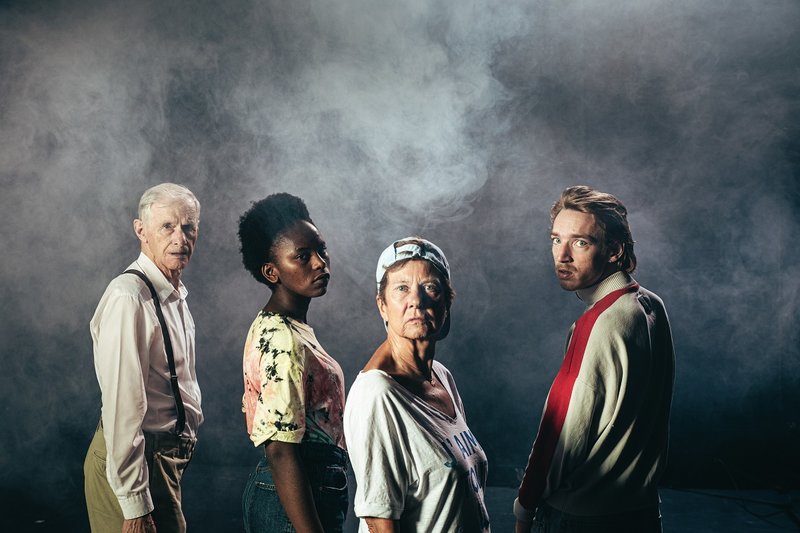
Have you ever wondered; how do I want to die ? How do I want people to say goodbye to me ? And how should people remember me ? The question of parting, mourning and death affects us all, but also of memory and solidarity in dealing with the end. These are the questions and topics dealt with in Grief and beauty. The personal lives of the actors and the story of Johanna are the central stories in this play by Milo Rau.
Who do you share your pain with ? Milo Rau, in the performance corresponding to the
second part of his « Trilogy of Private Life », transports the audience into the lives of the actors on stage. It is in this way that the spectator involuntarily enters an intimate environment. Almost as if he or she were playing the role of a trusted friend for each of the characters. The environment is familiar, a house that could be anyone’s and no one’s, domestic and yet glacial.
We remain trapped in stories poisoned between reality and fiction, between what has really been experienced and felt, and what remains hidden.
Is what we are seeing real ?
We are the visitors of those events, of that suffering. Those who have suffered the pain are telling it to us cruelly. We can do nothing but wonder if it is possible to tell such an affliction to a theater that has hundreds of ears. Talking is a necessary process for you and your feelings. If you talk in the mind, everything swings around and gets lost. When you talk about it with someone, your words cannot get lost because you gave them to someone else. For this reason, it is essential to learn to share what you feel. The plane that divides actor and character becomes very thin, at times intangible, because the scriptwriter has ensured that the heart and soul of each performer can be seen in the lines.
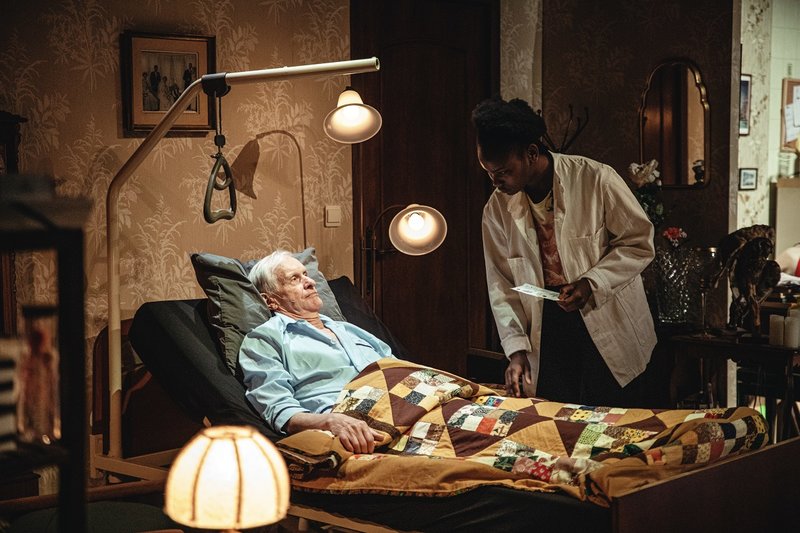
Milo Rau uses a variety of narrative methods to introduce us to these realities. The life stories evolve on several levels, through shots taken on the spot, which closely frame the faces of the actors. Also, through images and sounds that refer to moments of beauty in torment, through music and lights.
The gaze moves between one platform and another, following a thread that connects past and present, and it is precisely in one of these platforms that Johanna’s video appears. She is the woman who begins and ends the show, projected on a white panel, triumphant over every detail on stage, tangible if physically absent. She observes us from the moment we enter the room, as we take our seats, until we take off our coats and our gaze intertwines with hers. But suddenly, as the events unfold and the stories unfold, her eyes close blissfully. She remains motionless, lying on her bed.
Is what we are seeing real ? Is she really a dead, cold, pale body now? We can do nothing but watch her as she takes her last breath.
Her last sigh, her last words, her last day, with her family and friends, and now with us.
Real death on stage triggers strange sensations, always staged, caricatured, interpreted, and for once: real.
For once, beauty and pain.
Written by Marie-Lune Sablain and Alice Negri, part of Teenexters program
Photos : Next festival
 scenenews.news.blog