Pendant cinq jours, les TeeNEXTers ont assisté à des spectacles du festival NEXT, rencontré et interviewé des artistes, réalisé des reportages… Tous ensemble, ils ont tourné une émission pour raconter « leur » festival NEXT. A découvrir par ici :
TeeNEXTers est un projet porté par le Grand Bleu, avec le soutien de la Commission européenne (Erasmus +), du festival NEXT et de l’ESJ Lille.
Mathilde et Rafael ont rencontré Mathilde, étudiante à Lille : quelles sont ses passions, ses projets d’avenir, les lieux qu’elle aime… voici son portrait !
A different prospective on the performance »Shown and Told » through the words of the two artists.
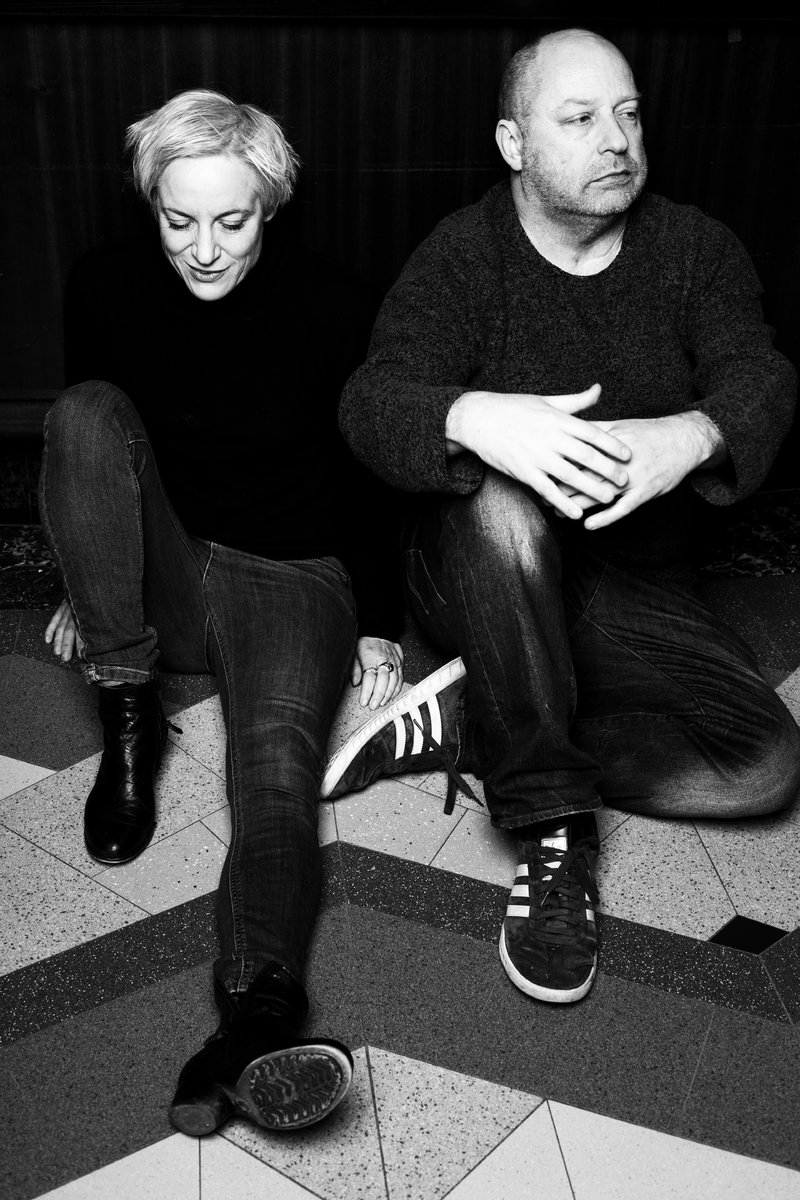
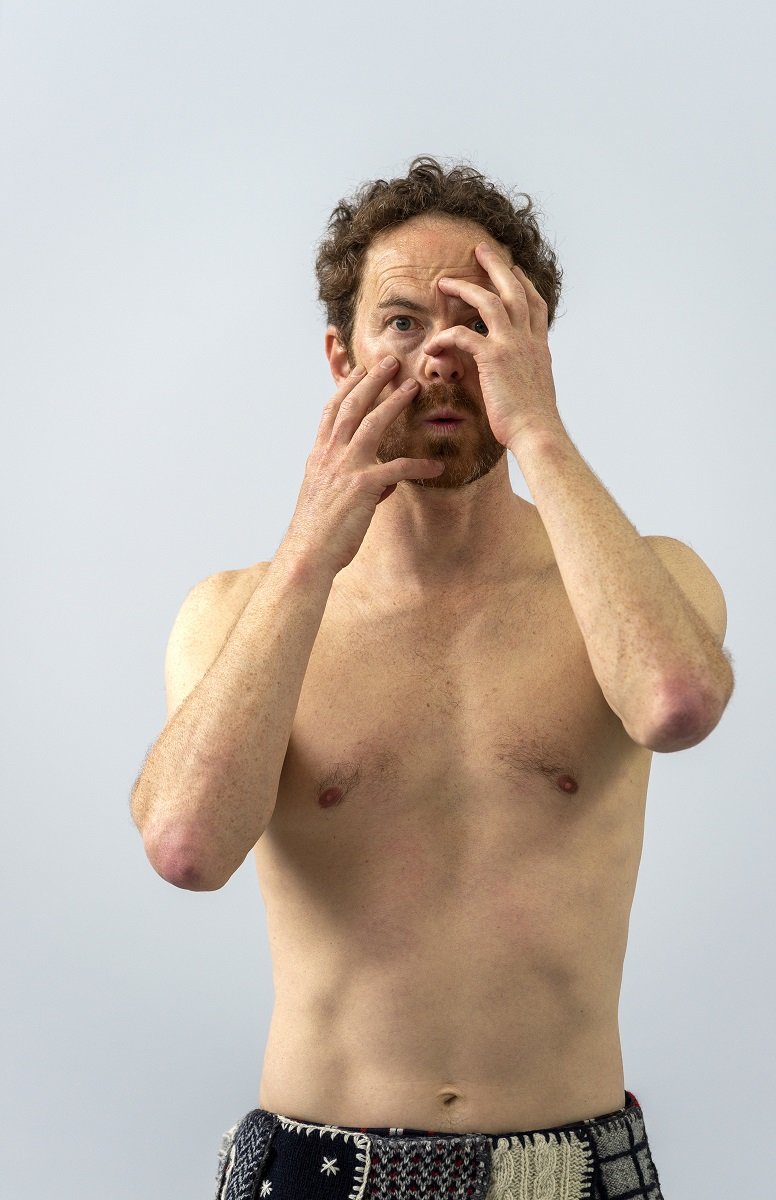
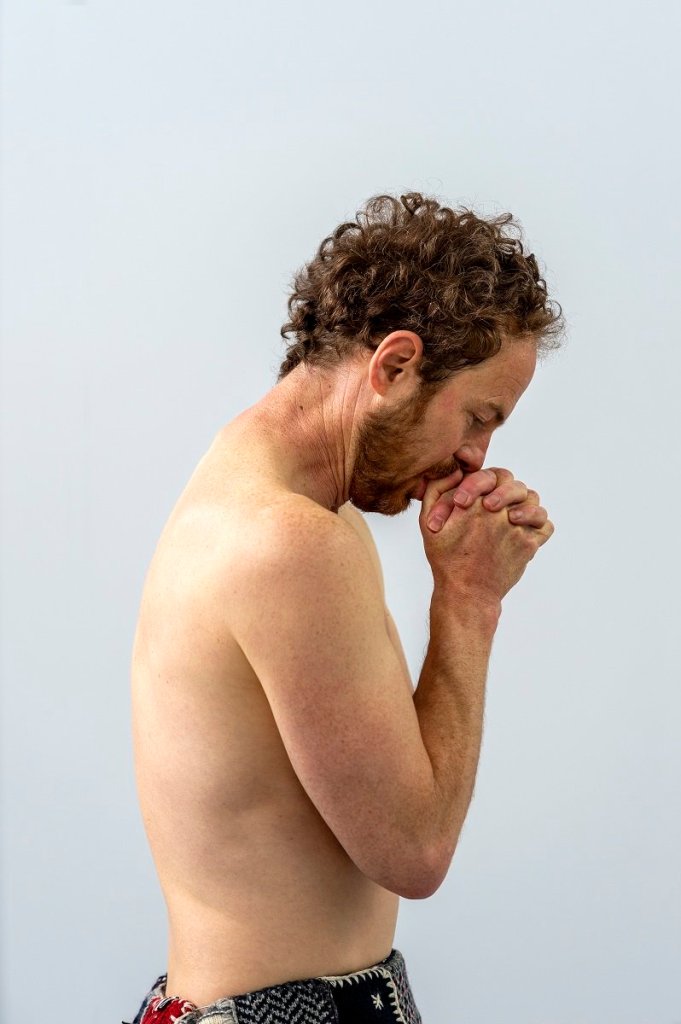
Shown and Told is a show performed by Meg Stuart and Tim Etchells for the Next festival at « De Shakel » theatre in Waregem in Belgium. As being part of the Teenexters’ project we had the chance to interview them right after we assisted to their performance.
Tim Etchells is a British artist and writer, leader of the artistic group Forced Entertainment, performing since 1984. The American Meg Stuart is the driving force of Damaged Goods and works from Brussels and Berlin. Although they usually work with their respective companies the two artists have known each other for many years and « have been in a conversation since the early ‘2000″.
The first fragments of this show were the result of some improvisation that the two made during a workshop together. Having seen a potencial in these first improvised sequences they continued to work on them and built a more structured performance. In fact, improvisation it’s a crucial element of this work that even when not improvised, wants to « look improvised ».
Photo : Next festival
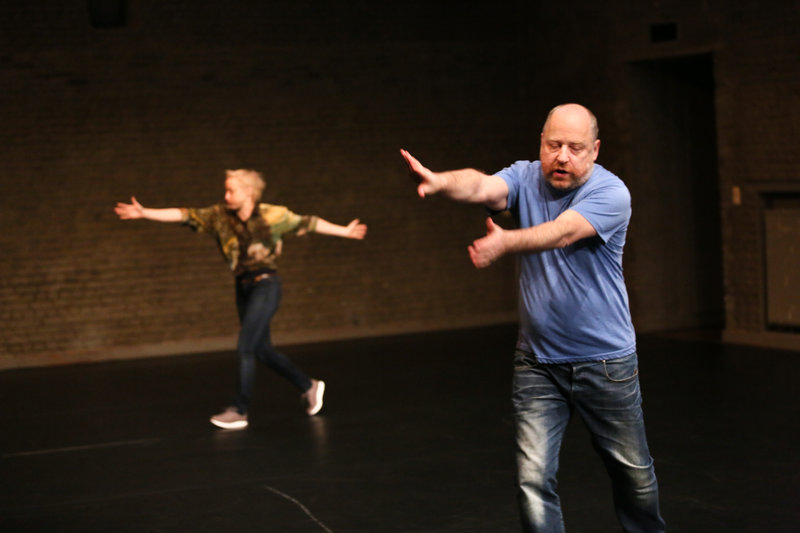
During the show the stage is bare. The spectator’s attention is all drawn by the moving bodies of Tim Etchells and Meg Stuart. Tim Etchells is manly in charge for the linguistic and speaking part, Meg Stuart for dancing and moving, but in a versatile way the two try to create a dialogue that goes beyond their usual identities as artists. The roles sometime get mixed: Meg Stuart is speaking, Tom Etchells is moving as he says laughing « I wouldn’t call dancing what I do ».
It’s a performance that wants to explore some of the possible meeting points between these different practices of language and movement. However, the two artists are not looking for a perfect correspondence between spoken words and the use of body. Sometimes the two are corresponding and miming each other but for most part the balance between the two is uneven, « going back and forth between the two » using Tim Etchells’ words . » The language is only one thing while there are always many more layers of interpretation of the movement ». But at the same time moving and speaking are not conceived as completely different practices. « For me talking is also moving, there is a physicality in the talking that I pursue ».
Another standing out feature of this performance is its fragmentary structure. Fragments of movement and spoken words follow one another, as Meg Stuart underlines « is important to build something and then leave it and move to another ». In this poetic and comical flow of fragments, repetitions, sounds, words and movements, as spectators, we don’t have to look for a particular sense, as Tim Etchells concludes our interview: « Lack of balance is important, I think keeping the meaning in this state of trembling uncertainty is maybe the biggest thing ».
Written by Nora Figari, from the Teenexters’ program Photos : Next Festival
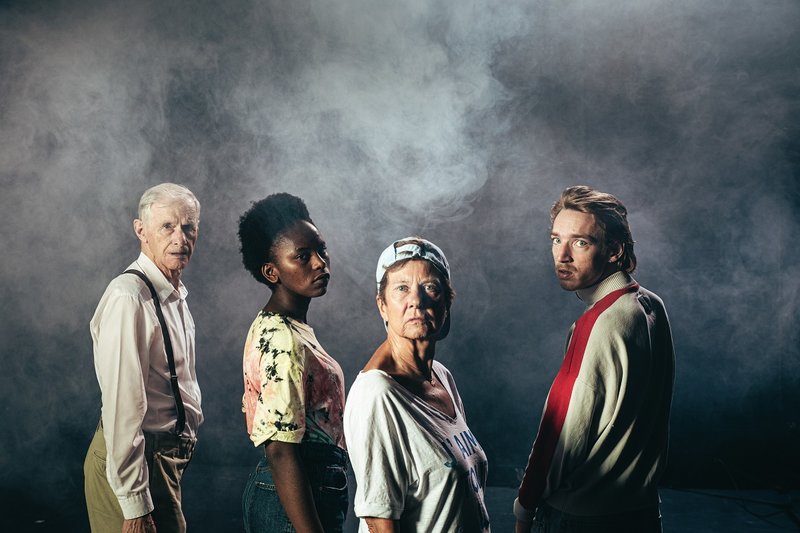
Have you ever wondered; how do I want to die ? How do I want people to say goodbye to me ? And how should people remember me ? The question of parting, mourning and death affects us all, but also of memory and solidarity in dealing with the end. These are the questions and topics dealt with in Grief and beauty. The personal lives of the actors and the story of Johanna are the central stories in this play by Milo Rau.
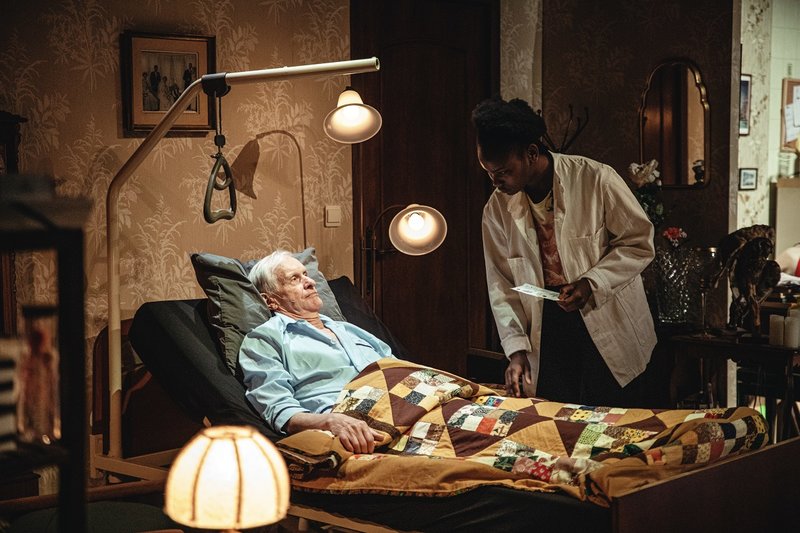
Who do you share your pain with ? Milo Rau, in the performance corresponding to the second part of his « Trilogy of Private Life », transports the audience into the lives of the actors on stage. It is in this way that the spectator involuntarily enters an intimate environment. Almost as if he or she were playing the role of a trusted friend for each of the characters. The environment is familiar, a house that could be anyone’s and no one’s, domestic and yet glacial.
We remain trapped in stories poisoned between reality and fiction, between what has really been experienced and felt, and what remains hidden.
Is what we are seeing real ?
We are the visitors of those events, of that suffering. Those who have suffered the pain are telling it to us cruelly. We can do nothing but wonder if it is possible to tell such an affliction to a theater that has hundreds of ears. Talking is a necessary process for you and your feelings. If you talk in the mind, everything swings around and gets lost. When you talk about it with someone, your words cannot get lost because you gave them to someone else. For this reason, it is essential to learn to share what you feel. The plane that divides actor and character becomes very thin, at times intangible, because the scriptwriter has ensured that the heart and soul of each performer can be seen in the lines.
Photo : Next festival
Milo Rau uses a variety of narrative methods to introduce us to these realities. The life stories evolve on several levels, through shots taken on the spot, which closely frame the faces of the actors. Also, through images and sounds that refer to moments of beauty in torment, through music and lights.
The gaze moves between one platform and another, following a thread that connects past and present, and it is precisely in one of these platforms that Johanna’s video appears. She is the woman who begins and ends the show, projected on a white panel, triumphant over every detail on stage, tangible if physically absent. She observes us from the moment we enter the room, as we take our seats, until we take off our coats and our gaze intertwines with hers. But suddenly, as the events unfold and the stories unfold, her eyes close blissfully. She remains motionless, lying on her bed. Is what we are seeing real ? Is she really a dead, cold, pale body now? We can do nothing but watch her as she takes her last breath.
Her last sigh, her last words, her last day, with her family and friends, and now with us. Real death on stage triggers strange sensations, always staged, caricatured, interpreted, and for once: real. For once, beauty and pain.
Written by Marie-Lune Sablain and Alice Negri, part of Teenexters program Photos : Next festival
Alice Negri, Anna Giulia Mauro and Viva Tange, three girls adhering to the TeenNEXTers project, tell us, in this critical article, about the only “SOMNOLE”, viewed during the NEXT Festival.
Photo : Next festival
Remove dance from formal constraints, break it down and rearrange it, to get to know it in depth, to know how to shape it.
Adapt your body to greater possibilities, use the stage as a laboratory, experiment, to fuel thediscovery of new physical languages.
All of this French director, choreographer and dancer Boris Charmatz works with all of this.
As soon as the lights of the theater come on, what we see is the body of a man overwhelmed by the call of sleep, who lets himself be led by it into a dimension of profound dozing. This state of alienation, this condition that still the body of Boris Charmatz on the ground, is interrupted by the slow, but inevitable recovery, a desperate rebirth. It is the melody of a faint whistle, the one that accompanied his body in the course of his awakening.
But how do you get out of hibernation?
How do you learn to walk again, in a world we no longer recognize? The dancer and choreographer Boris Charmatz shows us the difficulties that can entail coming out of isolation. He does this through extreme effort, with whistle that changes over time, similar to a panting cry. Through the sweat, which flows up his tense muscles.
We can only be spectators of such profound suffering, of an acute effort, so sharp as to break the fourth wall, totally involving the public. While the dancer rediscovers the rooms of his unconscious, poised between dream and reality, between awakening and relapse into the limbo of latency, his incessant whistle continues. Sometimes it reaches very high peaks, at other times it becomes lower, following the trend of its movements.
The artist said he knew this sound, as a child, during recess, he whistled classical compositions, and during the performance he creates melodic reminiscences. Boris chooses not to live passively anymore, to not escape the light, open his eyes and escape from the dream-refuge.
His emotions, expressed through the movement of the body, snappy and then exhausted, suddenly vital and then barely tangible by reason, are expressed through the use of the body alone.
Why what else do you need?
A body long locked up, long held back, now shows us the disturbances of a mind. We cannot help but recognize them, recognize ourselves. We all wake up.
Alice Negri, Anna Giulia Mauro and Viva Tange Photos : Next Festival
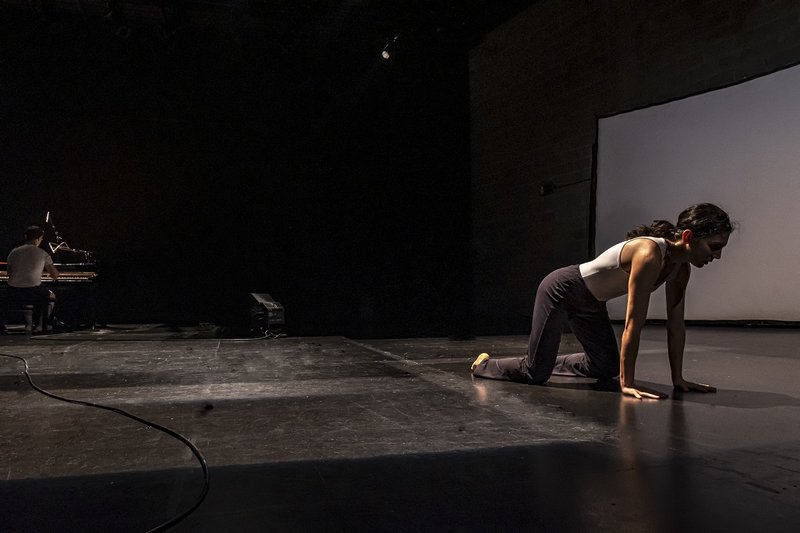
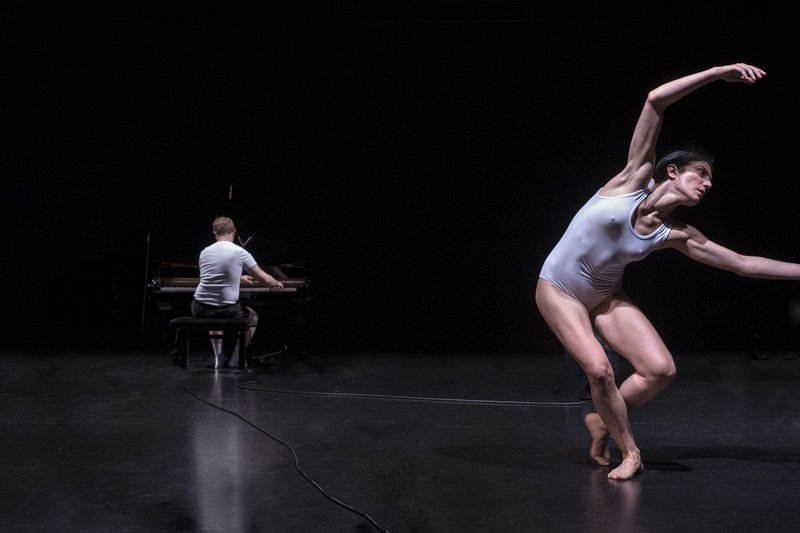
Have you ever heard a piano that had been manipulated by spikes? In Sonatas and interludes a powerful piece, performed by Lenio Kaklea you will experience this unnatural sound. Kaklea is a choreographer from Greece who began to create contemporary dance performances after her studies. She uses her body in a way only a few people dare to try. Together with the pianist, who plays the music that was written by John Cage, she creates a very spectacular piece.
The performance itself was very experimental with a theme that can be interpreted in different ways. For example, some saw it as growing up from a child to a woman and others saw this performance as letting go of expectations and prejudices. The particular reason for the circumstance of these differences of interpretation is also a difference of opinion about the play.
Some people were glaringly enthusiastic about the piece, about just getting across what was happening, and others were a little less enthusiastic. These felt more that it was a strange, repetitive piece. Of course, this style of dance has both supporters and detractors. But everyone is allowed to have their own opinion about the piece, which makes the discussion about it all the more interesting.
A creation under the spotlights
The dancer herself wanted to convey in this piece the way of moving and dancing from the time of John Cage, around the 1940s’. As she would put it herself: “It does not coat any dance from the 40s’, but it invites a vocabulary of that era.”
In addition to the choreography, there were several pluses to the performance. For example, the play of light was a great asset to the piece. Through the use of spotlights in different places and different types of light that the technicians played with brought more life into the austere performance.
Sonatas and interludes
A piano with spikes
The performance we saw was accompanied by the music of John Cage, a composer who died in 1992, but who has left a great impression on the music industry. The music that was played by the pianist put you in a certain mood. The music they used was a performance in itself due to the special use of screws placed on the strings of the piano. This gave very strange sounds, but that didn’t make them any less beautiful. You could hear that the piece was written to be played this way.
What was also striking was that the dancer sensed the music perfectly, so at certain moments she could do her movements exactly on the beat and at others she would counteract it completely. Because she had such a feel for the music, she could also start playing with it and this made it interesting for both the artist and the audience.
Lise Demuynck en Marie-Lune Sablain, TeeNEXTers 2021
Les 25, 26 et 27 juin, le Grand Bleu était à la gare Saint-Sauveur pour clore la saison en beauté, avec nos artistes associés ! Les reporters du labo médias étaient les envoyés spéciaux de ce week-end.
Le labo médias a participé au concours de podcast documentaire « Une fois, une voix », destiné aux jeunes de 11 à 19 ans. Le but: réaliser un documentaire sonore de 5 à 20 mn, autour du thème du travail des femmes.
Les participantes ont donc interrogé plusieurs professionnelles du spectacle vivant. Inégalités femmes/hommes, stéréotypes, harcèlement : même si les mentalités progressent et que certains écarts diminuent, la route est encore longue !
Pour l’écouter, c’est ici :
Merci à Jenny Bernardi, Séverine Coulon, Lila Maugis et Carole Thibaut qui ont répondu aux questions du labo.
Un podcast réalisé par Mayaé Bogaerts, Maud Dupon, Marine Evain, Marie Gréco, Léocadie Martin et Elora Veyron-Churlet.
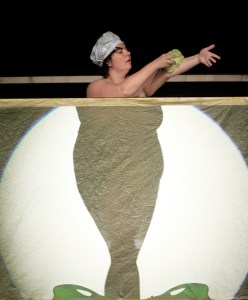
« Filles et soie », de et avec Séverine Coulon. Photo Jean Henry
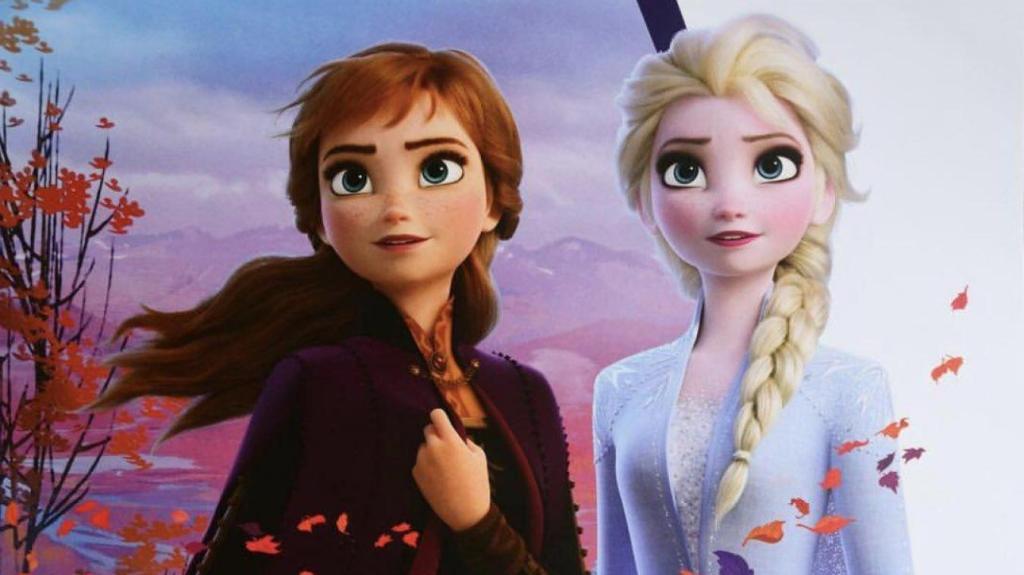
En 2019, six ans après le premier volet, La Reine des neiges 2, véritable conte de fées qui surfe sur la vague féministe a fait son apparition sur grand écran. Pourquoi est-il important de déconstruire ce stéréotype du prince pour avancer vers une société moins axée sur le patriarcat ?
Tout d’abord, un travail de définition : qu’est-ce qu’un stéréotype ? Selon le dictionnaire, ceux-ci représentent « des clichés, images préconçues et figées, sommaires et tranchées, des choses et des êtres que se fait l’individu sous l’influence de son milieu social (famille, entourage, études, profession, fréquentations, médias de masse, etc.) et qui déterminent à un plus ou moins grand degré ses manières de penser, de sentir et d’agir».
Par exemple, l’image la plus commune que nous avons du prince charmant qui vient sauver une princesse d’une malédiction. Ainsi, la littérature jeunesse ou encore les fameux Disney contribuent pleinement à l’intériorisation de normes de genre : les filles et les garçons façonnant leur identité à partir de modèles genrés les amenant à intérioriser des limitations et des places préétablies : on donne aux petits garçons le modèle du héros fort, intelligent, courageux, et aux petites filles le modèle de l’héroïne bien plus soucieuse de ses histoires de cœur qu’autre chose.
Et si l’on s’intéresse même de plus près aux histoires contemporaines mettant en scène des héroïnes courageuses comme La Reine des neiges, on remarque qu’elles sont très souvent secondées et épaulées par un voire plusieurs personnages masculins. Dans La Reine des neiges, Anna est bien aidée par Kristof, mêmes si les hommes du film sont aux antipodes du stéréotype du prince charmant. Mis à part le prince Hans, qui souhaite se marier dans le seul but d’accéder au pouvoir. Disney fait en quelque sorte son autocritique, et dénonce le mariage arrangé de l’ancien régime. En se rendant compte du stratagème, Anna prend conscience de sa condition de femme et devient maîtresse de son propre destin par l’amour non pas d’un homme mais d’une sœur.
Malheureusement, nous retrouvons le fameux anti-prince charmant un peu maladroit avec Kristof, une solution déjà utilisée chez Raiponce pour éviter le cliché du beau gosse qui va, évidemment, tomber amoureux d’Anna. La seule nouveauté réside sur le manque de confiance du jeune homme, alors que chez Raiponce, les producteurs se moquaient de cet homme trop présomptueux.
Une émancipation timide
Quel est le message que l’on transmet, une femme ne pourrait pas être capable de s’en sortir sans l’aide d’un homme ? Ici, le côté féministe ne se trouve donc que sur Elsa, figure de la sorcière, archétype de la féministe par excellence. Victime de ses pouvoirs qui la contraignent à s’exiler de la société, longtemps stigmatisée : celle qui ne correspond pas aux normes, célibataire, désintéressée des hommes, femme de pouvoir rongée par le besoin de liberté, d’indépendance pour vivre sa vie comme elle l’entend en pleine possession de ses pouvoirs.
Certes, on est loin des débuts de Disney avec Blanche-Neige, me too est passé par là. Le conte sort du schéma classique de la femme reléguée à l’espace privé (tour, château, maison), dans l’attente d’un homme qui s’occupe des affaires publiques (roi, prince…) car Anna, malgré un désir de mariage, mène son compagnon à la baguette pour mener seule son destin hors du royaume. Pourtant l’émancipation reste timide, Anna et Elsa restent des princesses ! Très belles, minces, très maquillées en particulier dans leurs figurines stéréotypées qui envahissent les supermarchés. C’est tout le paradoxe et en même temps toute la force de l’univers Disney.
Le conte de fées traditionnel donne une certaine image du féminin et tend à présenter la princesse comme l’incarnation d’un idéal. Le physique reste l’une des qualités principales que se doit de posséder une princesse. De plus, ces qualités physiques sont associées à des qualités de cœur : la douceur et la sagesse de ces personnages leur permettent de faire le bien autour d’elles. Anna n’échappe pas à la règle et est par ailleurs une jeune fille très naïve, comme l’était Blanche-Neige même si on peut accorder au conte qu’elle ne soit pas cantonnée à la passivité. Bien qu’Elsa reste victime d’une malédiction (tirée des contes traditionnels, comme dans La Belle aux bois dormant), l’histoire se termine non pas par un mariage mais par une princesse qui devient actrice de sa vie.
La stratégie, ici, est donc de proposer une image plutôt émancipée de la femme au niveau de l’histoire pour attirer un nouveau public, sans remédier aux ventes massives de produits dérivés extrêmement genrés. Bref, un début d’émancipation certes, mais point trop n’en faut. Et ça marche ! Le premier volet a même inspiré à certains un modèle d’émancipation pour la communauté LGBT.
Nous sommes pourtant bien loin de la princesse féministe qui révolutionnerait les contes traditionnels, personnage principal féminin ne veut pas dire féministe. Mulan, sortie en 1999, était finalement bien plus émancipée que La Reine des neiges.
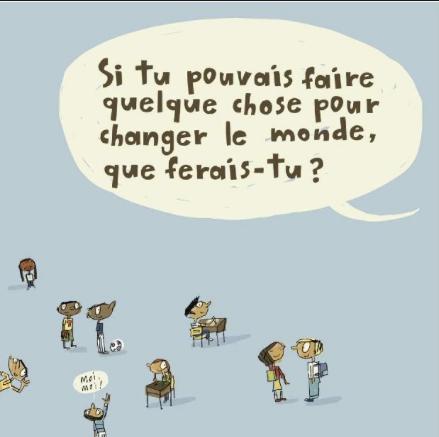
Si vous pouviez changer quelque chose dans le monde… Qu’est-ce que ce serait ? Elora Veyron-Churlet et Gabrielle Vandenberghe ont tendu leur micro aux Lilloises et aux Lillois.


 scenenews.news.blog